
Production & Workflow
Interactive Music Production Lessons Work
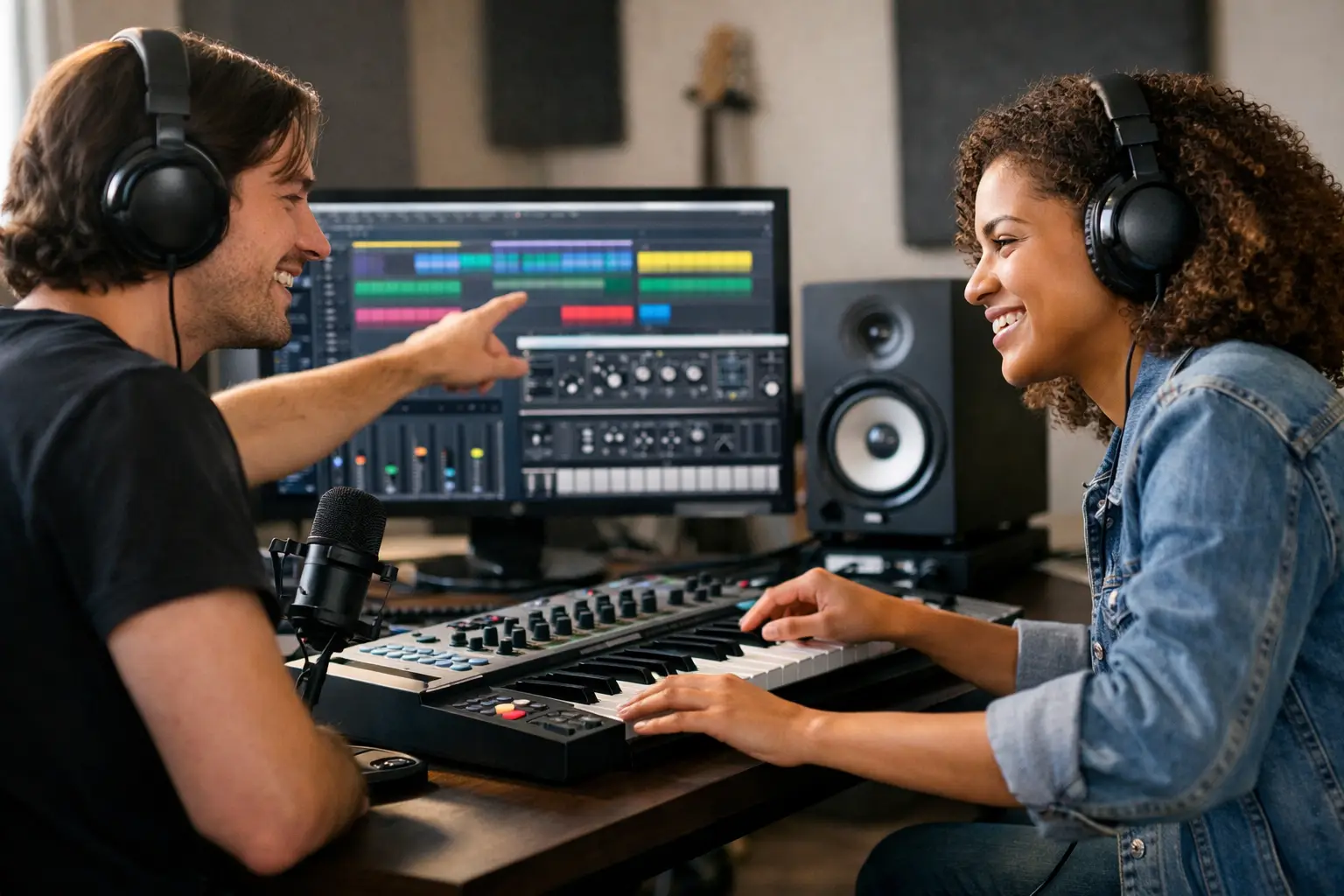
You can watch three hours of beat tutorials, save twelve tabs for later, and still end the night with the same eight-bar loop. That’s the trap a lot of producers get stuck in. Interactive music production lessons change that by turning learning into something you do, test, repeat, and level up through instead of something you just consume.
For beginner and intermediate producers, this difference is huge. Passive content feels productive because you’re exposed to ideas. But exposure is not the same as control. Knowing what a compressor does in theory is one thing. Hearing when your attack is choking a snare and fixing it on purpose is a different quest entirely.
Why interactive music production lessons stick better
Most people don’t quit music production because they lack interest. They quit because the learning path feels like a foggy dungeon. One video teaches sidechain. Another explains synthesis. Then a forum thread sends you into gain staging, and suddenly you’ve spent an hour comparing plugins instead of making anything.
Interactive music production lessons solve that by replacing random content grazing with progression. Instead of being told information and hoping it sticks, you’re asked to make a decision, complete a task, answer a quiz, train your ear, and prove you understood the mechanic before moving on.
That matters because music production is a performance skill. It behaves more like learning a game or an instrument than cramming for a test. You improve through reps, not just recognition. If your learning system doesn’t force reps, your progress stays fragile.
There’s also a motivation angle that gets overlooked. Traditional courses often ask for a lot of discipline upfront. Watch the module, take notes, maybe open your DAW later. Interactive systems flip that loop. They give you a clear mission now, immediate feedback now, and a visible reward now. That makes it much easier to keep showing up, especially on low-energy days.
What makes a lesson actually interactive
A lesson is not interactive just because there’s a play button and a worksheet. Real interactivity means your input changes the experience. You answer, build, identify, edit, or troubleshoot something, and the system responds.
In music production, that can look like guided DAW tasks, ear training drills, timed challenges, mix correction exercises, checkpoint quizzes, or software-specific missions that ask you to create a patch, shape a drum groove, or solve a routing problem. The point is active participation.
The best lesson design also gives you short feedback loops. If you place notes off-grid, misidentify a frequency range, or choose the wrong envelope setting, you should know quickly. Fast correction helps your brain connect cause and effect. That’s when technique starts becoming instinct.
This is also where game mechanics can help, if they’re used for the right reason. XP, achievements, streaks, boss battles, and progression maps are not just there to look cool. They work when they reinforce consistency and make effort visible. For producers who struggle with unfinished projects and scattered practice, seeing progress in concrete terms can be the difference between dropping off and building a real habit.
The biggest problem with passive tutorials
Passive tutorials aren’t useless. They can inspire you, introduce a tool, or show a workflow trick. But they break down fast when they become your main learning system.
First, they create an illusion of competence. If a creator explains EQ clearly, it feels like you learned EQ. Then you open your own session and realize your ears still don’t know what 300 Hz mud sounds like. That gap is frustrating, and a lot of new producers take it personally when it’s really a training design problem.
Second, passive content usually doesn’t care what you forgot. It keeps moving whether you retained anything or not. Interactive systems can slow the pace, revisit weak points, and make you earn the next checkpoint.
Third, scattered tutorials rarely build in sequence. One day you’re watching a video on mastering. The next day it’s chord extensions. Then vocal chains. That can be fun, but it’s a rough way to build fundamentals. If your foundation is shaky, advanced techniques won’t land cleanly.
There’s a trade-off here. Open tutorial platforms are great for browsing and inspiration. Interactive systems are better for structured growth. A lot of producers need both, but if your main goal is measurable improvement, structure usually wins.
Where interactive lessons help the most
The biggest gains usually show up in the areas where producers get overwhelmed early.
DAW navigation is a perfect example. Watching someone fly through Ableton or FL Studio can be weirdly discouraging when you still forget where the browser, mixer, or automation tools live. Interactive tasks make you use the DAW yourself, which helps build speed and confidence much faster.
Ear training is another major one. Many beginners try to skip it because it sounds technical or boring. But if you can’t hear interval movement, frequency buildup, stereo width, or compression changes, production feels like guessing. Interactive ear drills turn that abstract skill into a trainable stat.
Sound design also gets easier when lessons are hands-on. It’s one thing to hear someone explain oscillators, filters, envelopes, and modulation. It’s another to be challenged to build a pluck, a bass, or a pad under specific constraints. That kind of repetition helps synth knowledge stop feeling like wizard language.
Arrangement, mixing, and finishing tracks benefit too. These are the zones where many producers stall because there isn’t one perfect answer. Interactive challenges help by narrowing the mission. Instead of asking you to make a masterpiece, they ask you to solve a real production problem. That makes the process less intimidating and more repeatable.
Why gamified progress works for producers
A lot of creatives love the idea of discipline but struggle with consistency. That’s normal. Music production has a brutal mix of delayed rewards and endless options. Without some kind of momentum system, it’s easy to bounce between plugins, presets, and half-finished projects.
Gamified learning helps because it turns vague effort into visible progress. You’re not just “trying to get better.” You’re completing lessons, clearing challenges, gaining XP, earning achievements, and moving across a map with actual checkpoints. That sense of motion matters more than people admit.
It also lowers the emotional weight of practice. If every session has to produce a great song, you’ll burn out. If a session can simply mean clearing a lesson, beating a challenge, or improving one weak skill, you keep moving. Small wins stack.
Of course, the game layer can’t carry weak education. If the missions are shallow, rewards become decoration. The best platforms use progression to support curriculum, not replace it. That’s the sweet spot. SoundSurf leans into that by treating learning like an adventure path while still making you do the real work inside lessons, quizzes, ear training, and software-specific challenges.
How to tell if a platform will actually help you improve
If you’re choosing between different interactive music production lessons, don’t just look for flashy design. Look for proof that the system is built around skill transfer.
A strong platform should give you a clear path from fundamentals to more advanced topics. It should include active recall, not just explanations. It should revisit skills over time so you don’t beat one lesson and instantly forget it next week. And if it covers specific DAWs or synths, it should teach them in a way that matches how producers really work inside those tools.
Feedback quality matters too. Even simple checks can make a difference if they happen at the right moment. The more a system helps you catch mistakes early, the faster you improve.
You should also think about your own learning style. If you love freedom and hate structure, a tightly guided path might feel restrictive at first. But if your current method has left you with fifty saved videos and no finished tracks, a little structure is probably not the enemy.
The real question is simple: does the lesson make you do something that builds a usable skill? If yes, you’re training. If not, you’re mostly spectating.
The future of learning production is more active
Music production education is shifting away from the old model of endless lectures and toward systems that behave more like practice arenas. That’s a good thing. Producers don’t just need information. They need repetition, feedback, challenge, and a reason to keep coming back tomorrow.
Interactive learning won’t magically remove the hard parts. You still need patience. You still need to finish bad drafts, train your ear, and wrestle with tools that don’t make sense yet. But a better learning format can make those hard parts feel like progress instead of punishment.
If your current routine is mostly watching, bookmarking, and forgetting, it may be time to stop treating production like a spectator sport. The fastest path forward usually isn’t more content. It’s better quests.