
Music Theory & Composition
Music Theory for Producers That Builds Tracks
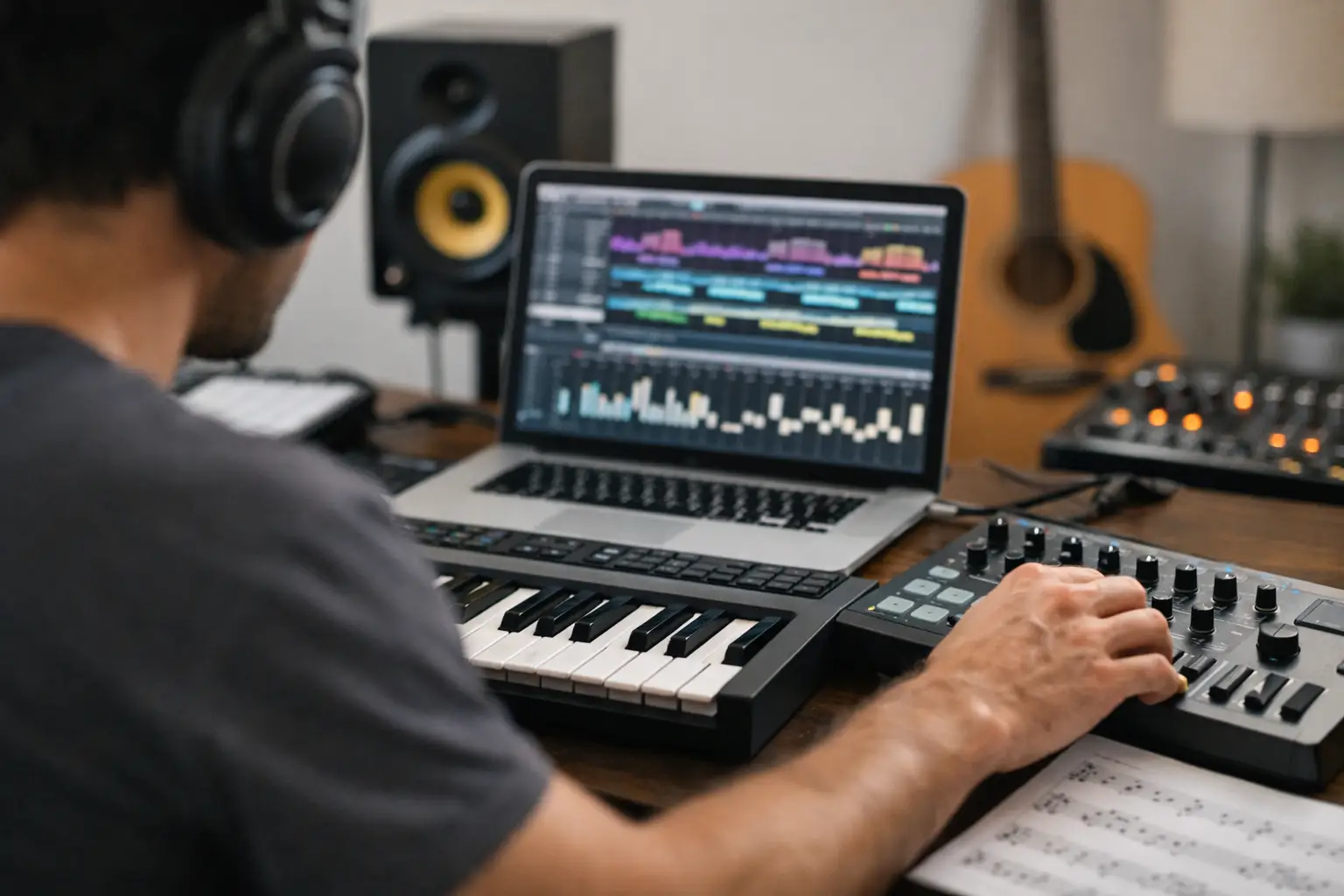
Your loop has great drums, a bass that hits, and a synth sound you spent 40 minutes shaping. Then comes the hard part: turning four bars into a track that feels like it knows where it is going. This is where music theory for producers earns its XP. Not because you need to read a symphony score, but because theory gives you reliable moves when your ears say, “Something is off,” and you do not know what to change.
Think of theory as a galaxy map, not a rulebook. It shows the routes that create stability, suspense, release, and surprise. You can still fly into weird territory. You will just know whether you are choosing chaos or accidentally landing there.
Music Theory for Producers Starts With Your Ears
The fastest way to make theory feel useless is to memorize labels without hearing them. Knowing that a chord is called a minor seventh does not help much if you cannot recognize the warmer, more open feeling it brings to your progression.
Start every concept inside a session. If you learn a scale, make an eight-bar melody with it. If you learn a chord type, play it against a bass note and listen to the color. If you learn a rhythmic idea, program it into your drums before moving on. Your DAW is the practice arena, and your ears are the final boss.
This also means you do not need to learn everything in historical order. A producer making house, trap, pop, or cinematic beats can get useful results from a focused set of concepts: keys, scale degrees, chord movement, rhythm, and tension. Counterpoint and advanced modulation can wait until your tracks ask for them.
The First Dungeon: Keys and Scales
A key is the home base of a track. It tells you which notes are most likely to work together and which note feels like “home.” A scale is the collection of notes available around that home base.
For example, A minor uses A, B, C, D, E, F, and G. If your chords, bass, vocal chop, and lead mostly pull from those notes, the track will usually feel connected. That does not mean every note outside the scale is forbidden. A note outside the key can create a gorgeous moment of friction. But it should sound intentional, not like a MIDI note wandered into the wrong dungeon.
Begin with major and natural minor scales. Major tends to feel brighter or more resolved; minor often feels darker, heavier, or more reflective. Those are tendencies, not laws. Tempo, sound selection, rhythm, and voicing can completely change the emotional read.
Here is a useful production challenge: pick one key, such as A minor, and build a 16-bar idea using only its notes. Make drums, bass, chords, and a melody. Then deliberately add one outside note in the melody before a strong resolution. Listen to the difference. You are training your ear to hear tension, not merely avoid mistakes.
Scale Degrees Make Patterns Portable
Instead of seeing a progression as a string of note names, see each chord’s position in the key. In A minor, Am is i, F is VI, C is III, and G is VII. The progression Am-F-C-G can then be moved to another key without losing its underlying shape.
This is producer-friendly theory because it helps you steal structures, not sounds. Hear a progression you love? Work out its scale degrees, then rebuild the emotional engine with your own chords, tempo, groove, and palette.
Chords: Your Track’s Emotional Architecture
A chord is simply multiple notes played together, but its effect depends on more than the notes themselves. The same chord progression can sound intimate on a soft piano, massive on stacked supersaws, or nervous when chopped into a syncopated pluck pattern.
Start with triads: major, minor, diminished, and augmented. Major triads use a root, a major third, and a fifth. Minor triads lower that middle note by one semitone. That small shift is a major emotional lever.
Then add seventh chords when your progression needs more color. A minor seventh can make a chord feel smoother and more soulful. A dominant seventh often creates a strong desire to move somewhere else. These are not automatically “better” chords. Dense harmony can muddy a drop, especially when your bass, pads, vocals, and effects are already competing for space. Sometimes a clean two-note chord or simple triad wins.
The producer move that matters most is voicing. Voicing means how you arrange a chord’s notes across octaves. Put the root low, spread the upper notes apart, and the chord may feel wide and cinematic. Cluster the notes in the middle register, and it can feel tense or cramped. Keep your sub focused by avoiding big, complicated chord stacks below roughly the low-mid range.
Build Progressions That Have Somewhere to Go
A progression needs contrast. One common route is movement from stability, through tension, and back to release. In a minor key, i-VI-III-VII is a familiar, loop-friendly path. For a more directional feeling, try ending on the V chord and then returning to i.
Do not judge progressions by piano-roll appearance alone. Loop eight bars and change one variable at a time: the final chord, the bass note, the chord inversion, or the rhythm. Inversions are especially powerful. They use the same chord notes but place a different note on the bottom, creating smoother bass movement without rewriting the harmony.
If a progression sounds generic, the answer is not always “add more chords.” Try fewer chords with a better rhythm, a new inversion, or a melody that highlights a surprising note. Complexity is a tool, not an achievement badge.
Rhythm Is Theory You Can Feel
Many producers hear “music theory” and picture keys and chords. But rhythm is just as central. Groove comes from the relationship between pulse, subdivision, accent, silence, and repetition.
Start by knowing where the beat lives. In 4/4, there are four quarter-note beats per bar. You can divide each beat into eighth notes, sixteenth notes, triplets, or other subdivisions. A hi-hat pattern using straight sixteenths creates a different energy from one using triplets, even at the same BPM.
The magic is often in what you do not place. A snare slightly before or after the expected moment, a rest before a vocal phrase, or a bass hit that skips the downbeat can create anticipation. But if every element is syncopated, nothing feels grounded. Give the listener an anchor, usually through the kick, snare, clap, or repeating percussion pattern.
Run this challenge: program a one-bar drum groove, then make three versions. Keep one completely straight. Add syncopation to the second. In the third, remove one obvious hit instead of adding anything. Your ears will quickly learn that space has rhythm too.
Tension and Release Turn Loops Into Arrangements
A loop stays interesting when it changes its level of certainty. Tension makes a listener lean forward. Release lets them breathe, dance, or feel the drop land.
Harmony can create tension with a chord that wants to resolve, but arrangement does just as much work. Remove the kick before the drop. Filter the chords. Introduce a rising pitch, faster percussion, or a melody that climbs. Then simplify at the moment of release: hit the root note, bring back the full drums, or let a clear hook take center stage.
Use automation and sound design as theory allies. A riser does not replace harmonic tension, but it can amplify it. A chord progression does not need a giant build-up, but a small change in voicing or bass movement can make a section feel newly alive.
Turn Theory Into a Repeatable Quest
The trap is collecting concepts like loot and never equipping them. One focused skill per session beats an hour of random tutorial hopping. Learn a concept, hear it, use it in a track, and test whether you can recognize it again tomorrow.
A structured system like SoundSurf can make that loop easier to sustain: lessons give you the map, quizzes expose weak spots, ear training sharpens your instincts, and challenges force the knowledge into your DAW. The XP is satisfying, but the real reward is opening a project and knowing your next move.
For your next session, choose one key, write a four-chord loop, make the bass follow its roots, and create a melody that uses mostly chord tones. Then break one rule on purpose. That tiny experiment is how theory stops being homework and becomes part of your sound.