
Mixing & Mastering
Headphones Versus Studio Monitors: Which Wins?
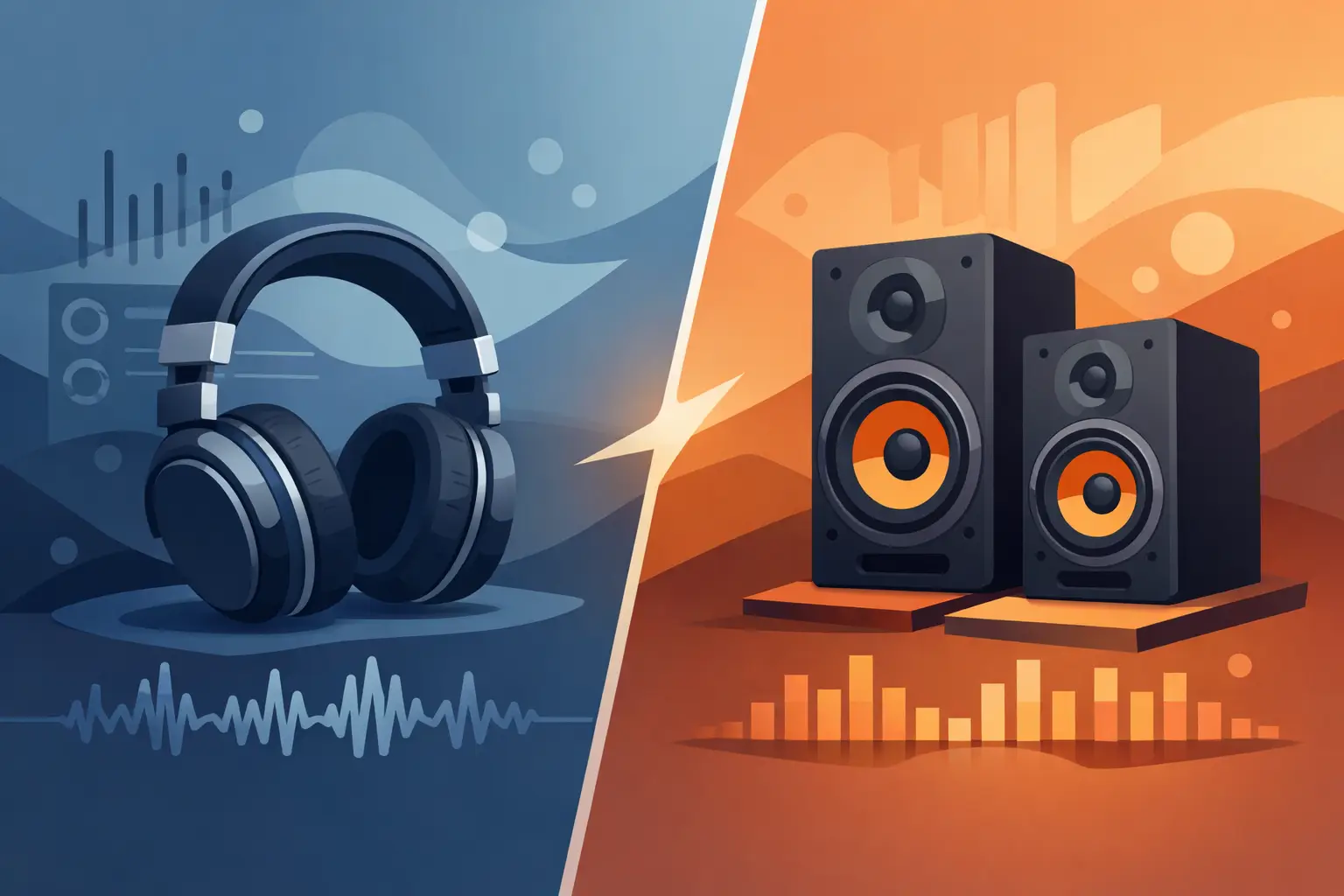
Your kick sounds massive at 1 a.m. in headphones. The next morning, you play the same track on speakers and suddenly the low end is a fog monster. That is the real headphones versus studio monitors battle: not which option is objectively better, but which one is telling you the truth you need at that moment.
For a bedroom producer, this is not gear trivia. Your monitoring setup affects every decision you make - EQ, panning, reverb, vocal level, bass balance, and whether your drop hits like a boss battle or lands like a wet cardboard box. The goal is not to pick a single winner. It is to learn what each tool reveals, what each tool hides, and how to use both without getting baited by your room or your ears.
Headphones Versus Studio Monitors: The Core Difference
Studio monitors play sound into a physical space before it reaches your ears. That space matters. Your desk, walls, windows, corners, and even the distance between your speakers can boost or cancel frequencies. A monitor might be relatively accurate, yet your room can turn its playback into a misleading quest map.
Headphones skip most of the room. The drivers sit close to your ears, giving you a direct and detailed view of the audio. That makes them incredibly useful for hearing tiny clicks, distortion, edit points, reverb tails, and problems buried inside a dense arrangement.
But headphones create their own illusion. Left and right channels are almost completely separated, so stereo width can feel huge. Low frequencies may feel exciting because they are physically close, while the sense of air moving through a room disappears. A mix built only on headphones can end up too wide, too dry, or oddly balanced when played through speakers.
Think of monitors as your open-world view and headphones as your inspection mode. Both are valuable. Neither should have the final word all the time.
What Studio Monitors Do Better
Monitors are usually the stronger choice for judging the big picture. When sound travels through the air, you experience the interaction between bass, midrange, high end, and stereo image more like a listener will in a room, car, venue, or living space.
Low End You Can Feel
A good monitor setup helps you understand whether the kick and bass are working together. You do not just hear the sub frequencies. You feel their weight and movement. That physical feedback makes it easier to judge groove and energy, especially in hip-hop, EDM, pop, and any genre where the low end carries the track.
There is a catch: small rooms can lie hard about bass. If your monitors are pushed into corners or parked against a wall, certain notes may boom while others seem to vanish. Do not assume your bass is wrong just because one note shakes the room. Check the mix at low volume, move around the room, and compare with reference tracks you know well.
More Realistic Panning and Depth
On monitors, the left speaker reaches both ears, as does the right speaker. That natural crossfeed helps you judge whether a vocal sits in front, whether a snare has enough center focus, and whether wide synths are swallowing the mix.
This matters because listeners rarely consume music with perfectly isolated channels. Speakers in a car, a phone, a café, or a party all blend sound in the air. If your mix feels balanced on monitors, it has a better chance of surviving outside your production dungeon.
Less Ear Fatigue During Long Sessions
Headphones can be fatiguing because the sound is so close. Monitors let you work at a comfortable, moderate level with more breathing room. You still need breaks - tired ears are a debuff no plugin can remove - but monitors often make long arranging and balancing sessions easier.
What Headphones Do Better
Headphones are not a compromise tool for producers who cannot afford monitors. They are a precision weapon, especially when used with intention.
Microscopic Detail
On headphones, you can catch mouth noise before a vocal enters, harsh resonances in a synth, clipping on a sample, sloppy fades, and reverb that lasts a beat too long. These details may be subtle on speakers, particularly in an untreated room.
They are also excellent for editing. If you are comping vocals, tightening drum transients, cleaning samples, or hunting for clicks in a loop, headphones get you close enough to see the pixels.
Reliable Listening in Bad Rooms
If you produce in a dorm, apartment, shared house, or bedroom with zero acoustic treatment, headphones may give you more reliable information than monitors. Your room does not get a vote. That is a huge advantage when you cannot place speakers properly or play music at useful volumes.
Open-back headphones are often preferred for mixing because they sound more spacious and natural. They leak sound, though, so they are a poor choice for recording vocals near a microphone. Closed-back headphones offer isolation and are better for tracking, commuting, and late-night production, but their low end and stereo image can be less neutral depending on the model.
Late-Night Momentum
Inspiration does not care that your neighbors have jobs. Headphones let you keep building when monitors are not an option. Just avoid the midnight trap of turning them up louder and louder. Loud feels better until it makes your decisions worse.
The Traps That Make Mixes Fail
The biggest problem is not choosing headphones or monitors. It is trusting either one blindly.
A headphone-only producer may overdo stereo widening because it sounds cinematic in isolated left and right channels. They may add too much reverb because headphones make the mix feel intimate and controlled. Then the track reaches speakers and turns cloudy.
A monitor-only producer in an untreated bedroom may make wild low-end choices based on room modes. They may keep boosting the bass they cannot hear, only to discover that their track is overpowering on earbuds. Or they may cut a frequency that only their room exaggerated, leaving the mix thin everywhere else.
There is another common enemy: mixing too loud. At high volume, bass and treble can feel more exciting, which makes a rough mix seem finished. Work mostly at a conversational level. If the vocal, snare, and main musical idea still make sense quietly, your mix has a solid foundation.
A Practical Hybrid Workflow
If you have both headphones and monitors, use them like a two-stage challenge rather than competing teams. Start on monitors for arrangement, level balance, panning, and broad EQ. Switch to headphones for cleanup, automation details, subtle effects, and problem-solving. Return to monitors before committing to major low-end or width decisions.
If you only have headphones, you can still make strong mixes. Build a repeatable reference routine. Listen to several professionally mixed songs in your genre through the same headphones before you mix. Notice where the vocal sits, how loud the kick feels, how bright the cymbals are, and how much sub energy is really present. You are training your internal compass, not copying a single track.
If you only have monitors, learn your room before buying more plugins. Play familiar tracks. Listen from your chair, then stand up, then move slightly left and right. If the bass changes dramatically, your room is affecting what you hear. Keep your monitors symmetrical, form an equilateral triangle with your listening position, and avoid placing them directly in corners.
Before you call a mix finished, run this four-part translation check:
- Listen quietly on your main setup. Can you still hear the vocal, snare, and musical hook?
- Check on headphones for clicks, harshness, over-wide effects, and messy reverb tails.
- Check on a phone or small speaker. Does the song still have a clear core when the sub disappears?
- Compare with one or two references at a matched volume. Is your mix brighter, darker, boomier, narrower, or less punchy?
This is not about chasing perfection across every device. It is about spotting patterns. If your bass is always too loud on other systems, that is a skill quest with a clear objective.
So, Which Should You Buy First?
Buy headphones first if you work in a noisy home, need to produce late, record vocals, travel, or cannot improve your room. A comfortable pair you learn deeply will beat cheap monitors placed badly on a desk every time.
Buy monitors first if you have a reasonably quiet space, can position them correctly, and want to make decisions about low end, balance, and depth with more real-world perspective. Even then, budget for basic setup improvements before chasing bigger speakers. Large monitors in a tiny untreated room are not an upgrade. They are a mini-boss with extra health.
The strongest long-term setup is usually both: monitors for perspective, headphones for detail, and reference tracks to keep your ears honest. SoundSurf-style progress comes from repetition, not from waiting for perfect gear. Pick the tool you can use consistently, learn its behavior, and treat every mix translation mistake as useful feedback for the next level.