
Production & Workflow
Signal Flow Master: Build the Perfect Audio Chain, One Decision at a Time
Published
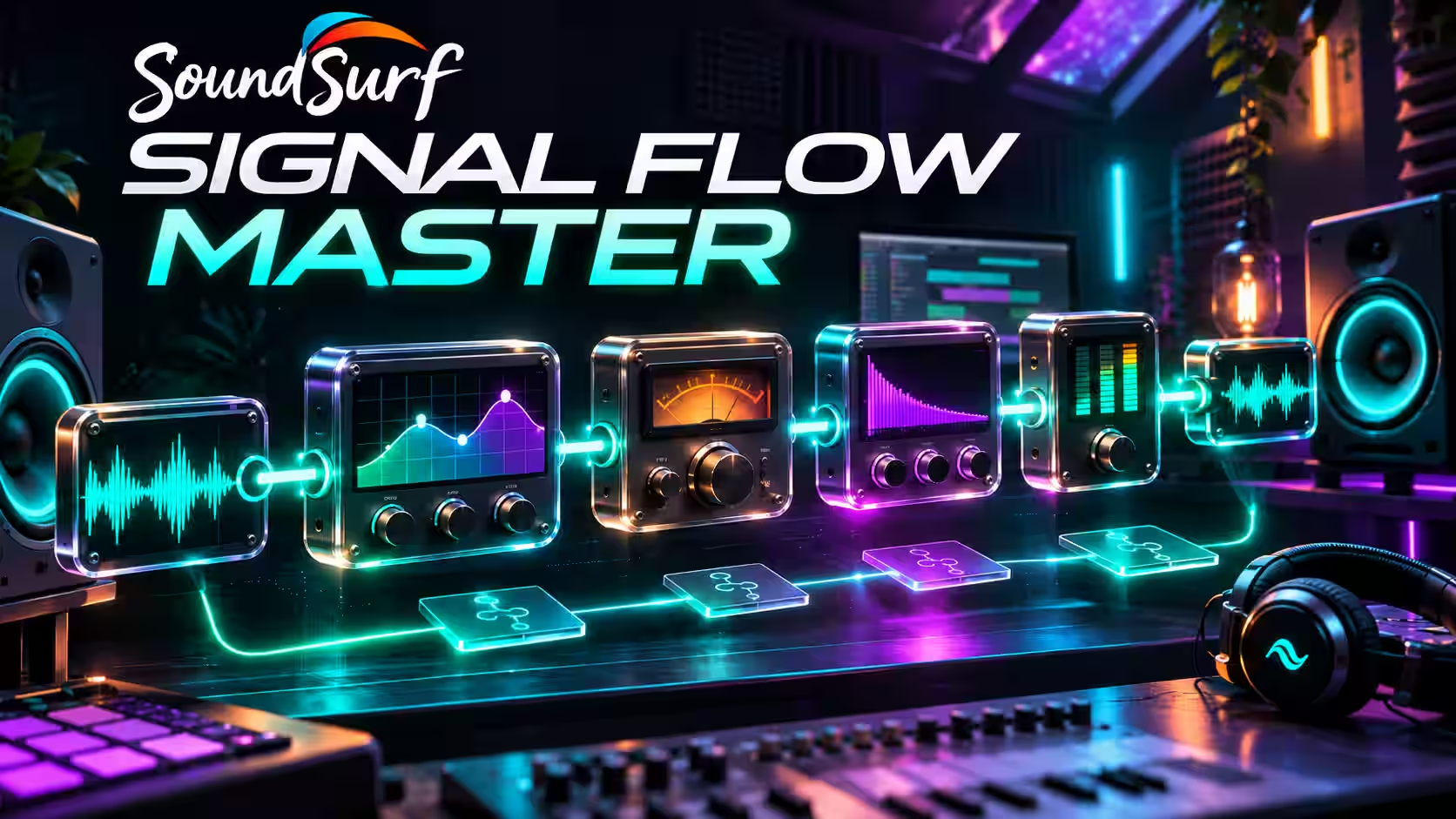
Every Great Mix Begins With the Right Connection.
A powerful kick. A perfectly controlled vocal. A wide, immersive synth. Behind every polished production is something most listeners never see: a carefully designed path that carries audio from its source to its destination.
That path is called signal flow. It determines how audio travels through your instruments, effects, channels, buses, and outputs — and how every processing decision changes what you hear.
With Signal Flow Master, SoundSurf turns this essential production skill into an interactive puzzle experience. Instead of memorizing diagrams or simply watching tutorials, you learn to think like an audio engineer by solving signal-chain challenges.
Connect the right elements. Understand the routing. Build a signal path that makes sense.
🎛️ What Is Signal Flow Master?
Signal Flow Master is a hands-on SoundSurf experience built around drag-and-drop signal-chain puzzles. The goal is to develop a practical understanding of how audio moves through a production or mixing setup.
A signal chain can look simple on the surface: an instrument enters a channel, passes through some effects, and reaches the speakers. But as sessions become more complex, every connection starts to matter.
What should happen before compression? Where does an auxiliary effect return? How is a sidechain different from the main audio path? And what happens when a signal is routed to the wrong destination?
Signal Flow Master encourages you to answer questions like these through decisions and problem-solving, not passive reading.
🧩 Learn by Building
Each puzzle is an opportunity to recognize the role of audio components and reason about the order or direction of a signal path. As you practice, the connections between familiar production tools become easier to understand.
The objective isn't simply to know what a plugin does. It's to understand where it belongs and why.
🔌 The Foundation — Follow the Audio
Before you can build advanced routing systems, you need to understand the journey of the signal itself.
🎤 Input — Where Sound Begins
Every signal flow begins with a source. It might be a microphone, an audio clip, a synthesizer, a sampled drum, or a virtual instrument inside your DAW.
Recognizing the source is the first step toward understanding what happens next. An acoustic recording may pass through a microphone preamp and an audio interface, while a software synthesizer generates audio directly inside the project.
🎚️ Gain Staging — Protect the Signal
Every gain adjustment changes the level reaching the next processor. If the signal is too hot, a downstream stage may distort. If it is too low, the chain may become harder to manage.
Learning signal flow helps you stop treating every volume control as interchangeable. Input gain, plugin output gain, channel faders, bus levels, and monitor volume serve different purposes.
🔊 Output — Where the Signal Goes
Processing is only useful if the signal reaches its intended destination. That might be a group bus, the stereo master, a recording track, a headphone cue mix, or an external audio output.
A perfectly processed sound routed to the wrong bus can disappear from the mix or appear in an unexpected place. Understanding destinations is just as important as choosing effects.
⚙️ Signal Chains — Why Processing Order Matters
Two chains can contain the same plugins and still produce noticeably different results. The reason is simple: each processor reacts to the signal it receives.
🎛️ EQ Before or After Compression?
Imagine a bass recording with excessive low-frequency energy. If you reduce that energy before the compressor, the compressor may respond differently to the cleaned-up signal.
Put the same EQ after compression and it changes the tone of an already compressed sound, without changing what originally triggered the compressor.
Neither order is universally correct. The key is to recognize that plugin order changes behavior and to choose a chain based on the problem you're solving.
🔥 Saturation, Distortion, and Dynamics
Saturation can introduce harmonics and change transient shape. Compression can control level variations and change the way those harmonics are perceived.
Place saturation before compression and the compressor reacts to the saturated signal. Reverse the order and saturation receives a more dynamically controlled input.
Understanding this relationship turns plugin order from a habit into a creative decision.
🌌 Reverb and Delay — Placement Creates Perspective
Spatial effects can be placed directly on a channel or accessed through auxiliary sends. These approaches offer different ways to control the balance between dry sound and processed ambience.
The routing you choose can affect clarity, flexibility, and how multiple instruments share the same virtual space.
🧠 Think Beyond a Straight Line
Real production sessions rarely consist of one simple line of plugins. Professional workflows often involve multiple paths, shared processors, and signals that control other signals.
🚌 Buses and Group Routing
A drum bus lets you route multiple drum channels into a common processing path. Instead of compressing each individual sound in isolation, you can process the combined drum signal as a group.
Understanding where individual tracks meet — and where their combined signal travels afterward — is a fundamental part of managing larger sessions.
🔀 Parallel Processing
Parallel processing creates multiple paths from a source, allowing an unprocessed or lightly processed signal to be blended with a more heavily processed version.
Parallel compression, for example, can preserve transient detail while adding density through a second, compressed path. But good results depend on understanding splits, returns, levels, and potential timing or phase interactions.
🎯 Sidechain Routing
In sidechain compression, one signal can control the dynamics processing applied to another. The familiar kick-and-bass relationship is one example: the kick can trigger gain reduction on the bass channel.
The distinction is crucial: the signal used for detection isn't necessarily part of the audio heard at the output.
Once you understand this separation, sidechain routing becomes easier to analyze and troubleshoot.
🏆 Five Levels of Signal Flow Mastery
Signal Flow Master is organized around a learning progression from Beginner through Legend. Each tier represents a deeper level of signal-flow reasoning and production knowledge.
🌱 Beginner — Learn the Signal Path
Start with the essentials: sources, processors, audio paths, and outputs. Learn the vocabulary of signal flow and get comfortable following audio from one stage to the next.
⚡ Intermediate — Understand Processing Relationships
Develop a stronger understanding of effect order, gain changes, insert processing, and routing choices. The focus shifts from recognizing individual tools to understanding how they work together.
🔥 Advanced — Handle More Complex Chains
Explore the reasoning behind bus structures, shared effects, dynamic interactions, and more involved production setups. Learn to evaluate a chain rather than relying on a familiar preset order.
💎 Master — Think Like an Audio Engineer
Develop a systems-level view of the session. Consider multiple signal paths, creative routing, processor interactions, and the reasons one configuration may suit a particular mixing goal.
👑 Legend — Master the Entire Signal Architecture
At the highest level, the challenge is no longer just identifying the next processor. It's understanding the complete architecture: where audio enters, how it changes, what controls it, and where it ends up.
Real mastery means being able to explain every connection in your signal chain.
🚨 Troubleshooting — When the Mix Goes Silent
Signal-flow knowledge is one of the most useful troubleshooting skills a music producer can develop.
Imagine opening a project and discovering that one instrument is completely silent. You could start randomly clicking plugins, or you could trace the signal logically.
🔍 Trace the Signal Step by Step
First, confirm that the instrument or recording is producing audio. Then check the channel, plugin stages, gain controls, sends, bus routing, and final output destination.
If the source is active but a bus receives nothing, investigate the path between them. If the meters show audio but the speakers remain silent, examine the output and monitoring configuration.
Don't guess where the problem is. Follow the signal until you find where it stops.
🎧 Skills That Transfer to Your Real DAW
Signal-flow principles extend beyond any single digital audio workstation. The interfaces may look different in Ableton Live, FL Studio, Logic Pro, Pro Tools, or another DAW, but the underlying concepts remain remarkably consistent.
Tracks carry signals. Inserts process them. Sends create additional routes. Buses combine paths. Outputs connect your mix to the next stage of the audio system.
By practicing signal-chain reasoning, you build a mental model that can help you understand unfamiliar sessions, collaborate with other producers, and troubleshoot confidently.
💡 Build Better Habits in Every Session
Developing strong signal-flow instincts doesn't require an expensive studio. It starts with a few deliberate habits.
🧭 Ask Where Every Signal Goes
Before adding a processor or creating a send, identify the source and destination. Make sure the intended audio route is clear.
🧪 Change One Part of the Chain at a Time
When experimenting with plugin order, keep other parameters as consistent as possible. Compare the result and ask what changed — not just whether it sounds louder.
📐 Understand the Reason Behind the Routing
Avoid treating a favorite chain as a universal formula. A routing setup should serve the production goal, not the other way around.
🎮 From Theory to Instinct
Reading about signal flow is useful. Building chains and solving routing problems makes that knowledge easier to apply.
Signal Flow Master combines the logic of a technical skill with the satisfaction of solving a puzzle. Each challenge invites you to examine the relationship between audio components and think through the full path.
With practice, decisions that once required careful thought can become second nature. You begin to see your DAW as a connected system, rather than a collection of unrelated plugins.
Stop stacking effects blindly. Start building signal paths with purpose.
🚀 Ready to Become a Signal Flow Master?
Connect. Solve. Understand. Master.
Whether you're discovering audio routing for the first time or refining your understanding of more advanced signal chains, Signal Flow Master gives you a new way to approach one of the most important skills in music production.
Open Signal Flow Master in SoundSurf, explore the puzzle challenges, and work your way through the five difficulty levels.
Every sound has a source. Every connection has a purpose. Every great mix follows a path.
Can you master the flow? 🎛️⚡
SoundSurf — Stop Watching. Start Producing.
Sources and further reading
- Ableton Learning Music
Interactive examples of beats, notes, chords and song structure.
- Roediger and Karpicke (2006): Test-enhanced learning
Original experiments on recall and delayed retention of prose. This is not a study of SoundSurf or music-production outcomes.