
Production & Workflow
AI Music Production Coach for Better Practice
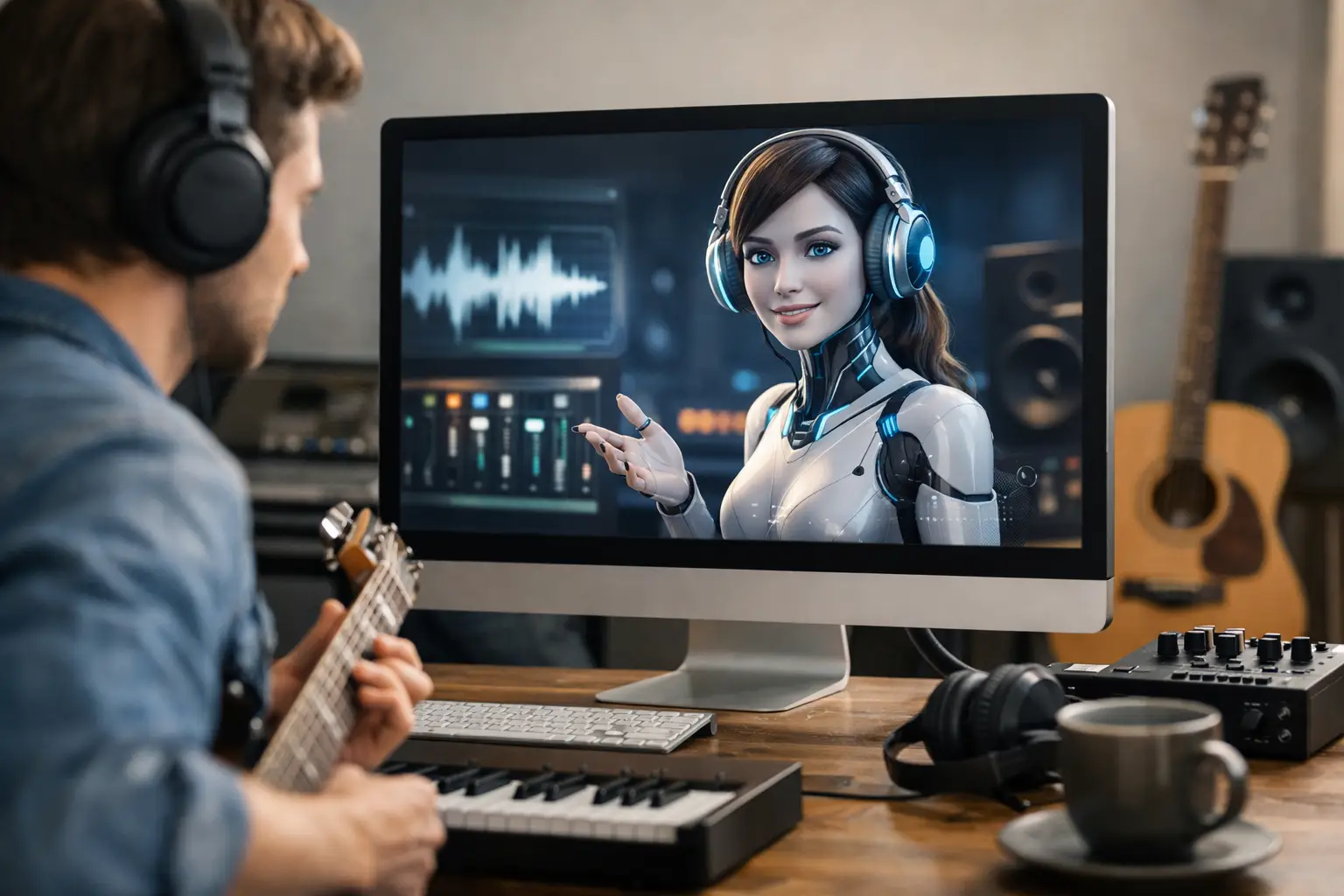
You have 40 minutes before dinner. You open your DAW, audition 12 kick drums, tweak a synth preset, watch half a tutorial, and close the project with the same loop you had last week. An AI music production coach is built for that exact moment: not to make the music for you, but to give your session a mission.
For beginner and intermediate producers, the hardest part is rarely finding information. There are more tutorials, sample packs, presets, and plugin walkthroughs than anyone could finish in a lifetime. The real boss battle is turning all that input into repeatable skills: writing better drum patterns, hearing muddy frequencies, arranging an eight-bar loop into a full idea, and knowing what to practice next.
A good coach creates momentum. An AI-powered one can make that momentum more personal, more immediate, and far less likely to disappear into the tutorial dungeon.
What an AI music production coach should actually do
The phrase can mean a lot of things. Some tools generate a chord progression or suggest lyrics. Others analyze a mix, answer production questions, or help organize a workflow. Those can be useful, but a real coaching experience goes further than producing a one-off answer.
A coach should help you identify the next skill worth training, give you a focused task, and help you reflect on the result. Think less “make me a Drake-style beat” and more “your drums feel static because every bar is identical. Create two variations for bars four and eight, then compare which one improves the energy.”
That difference matters. Generation can save time, but coaching builds ability. If a tool constantly fills in the creative gaps for you, it may help you finish more files while teaching you very little about why those files work. When it gives you a constraint, a clear target, and a reason for the task, you are the one gaining XP.
An effective AI music production coach can support several parts of the learning loop:
- It can turn a broad goal, such as “get better at house drums,” into a short, practical drill.
- It can adapt explanations to your DAW, whether you work in Ableton, FL Studio, Logic, Cubase, Pro Tools, or Studio One.
- It can quiz your understanding after a lesson instead of assuming that watching equals learning.
- It can suggest a next challenge based on where you got stuck, not just what lesson comes next in a generic course.
The best use is not replacing your taste. It is giving your taste more chances to develop through deliberate reps.
Why producers need coaching, not another content pile
Most music production learning has an invisible trap: it feels productive before it becomes productive. Watching a compression tutorial can be exciting. Building muscle memory by setting a threshold, ratio, attack, and release on your own audio is where the skill starts to stick.
This is why scattered learning often leads to unfinished tracks. One video teaches sound design, another teaches mastering, and a third promises a secret arrangement formula. None of those lessons are automatically wrong. But without a path, beginners tend to jump to the flashy stuff before their foundations can support it.
A coach can bring the galaxy map back into view. If you are early in your journey, your mission might be understanding gain staging, drum programming, and basic EQ before chasing advanced vocal chains. If you already finish demos but your drops lack impact, the mission might shift toward contrast, transitions, automation, and reference listening.
This does not mean every producer needs the same route. A singer-songwriter using Logic, a bass music producer in Ableton, and a hip-hop beatmaker in FL Studio will make different choices. The underlying learning system can still be consistent: learn a concept, apply it in a small task, get feedback, revisit it later, and use it inside a real track.
That is how practice becomes less random. You stop asking, “What should I learn?” every time you sit down and start asking, “Can I beat yesterday’s score?”
The feedback loop is the real power-up
The strongest case for AI in music education is not that it has every answer. It is that it can respond while your creative momentum is still alive.
Say you are trying to make a bassline feel tighter with your kick. Instead of pausing your session to search through ten unrelated videos, you can ask for a targeted explanation of sidechain compression, volume shaping, note length, or frequency overlap. A useful coach should then turn that explanation into action: try a short release, compare it with a longer release, and listen for whether the low end breathes or just disappears.
That last step is critical. Music production is an ear skill, not a vocabulary contest. You do not truly understand “mud,” “punch,” or “stereo width” because you can define the words. You understand them because you can hear a problem, make a change, and judge whether the change helped.
This is where challenges and ear training earn their place. A daily mission to identify a harsh frequency range, rebuild a drum groove by ear, or make a transition using only stock effects can teach more than another hour of passive browsing. Small challenges lower the pressure while increasing the number of meaningful decisions you make.
Platforms such as SoundSurf frame these reps as quests, achievements, and boss battles. That playful layer is not just decoration. Visible progress gives your brain a reason to return tomorrow, especially when the early stages of learning a DAW can feel like wandering through a control panel with 900 buttons.
How to use an AI music production coach without losing your voice
There is a trade-off with any smart tool: convenience can become dependence. If you ask AI to choose every chord, sound, arrangement move, and mix decision, your tracks may become technically tidy but personally blurry.
Use coaching to sharpen your decisions, not outsource them. Ask for options, then make a choice. Ask why a mix feels crowded, then test the fixes with your own ears. Ask for a 20-minute drill, then bend the rules if an unexpected idea appears.
A practical session can follow a simple rhythm. Start with one goal that is small enough to complete. For example: “Make the snare hit harder without increasing its peak level.” Spend 15 to 25 minutes testing only a few moves, such as transient shaping, layering, saturation, EQ, or a change in the pattern. Then listen back on headphones and speakers, write one sentence about what changed, and save a version.
The coach helps prevent scope creep. You are not suddenly redesigning the entire track because a snare task led you into a synth rabbit hole. You can always return to the larger project later. For now, the quest is clear.
It also helps to keep an idea log. When a challenge produces something cool, save the project, bounce a quick clip, and write down what you did. Over time, that log becomes proof that your creative instincts are growing. It is more motivating than judging yourself against polished releases made by teams with expensive studios.
What AI cannot hear for you
Even the smartest production coach has limits. It cannot fully know your artistic intent, your emotional reference points, or whether a strange choice is a mistake or the most interesting part of your song. It may recommend clean, familiar solutions when your track needs something rougher, emptier, louder, weirder, or more human.
It also cannot replace reference tracks, rest, and real-world listening. If your ears are tired, no prompt can fix that. If your mix only works on one set of headphones, you still need to test it elsewhere. If you want to understand a genre, you need to listen deeply to the genre, not just read a breakdown of it.
Treat AI feedback as a second set of training wheels, not a final verdict. When it suggests a change, compare before and after. If the original serves the song better, keep it. Your job is not to obey the oracle. Your job is to become a producer who can challenge the oracle with confidence.
Build a practice streak worth protecting
The producers who improve fastest are not always the ones with the most gear, the most plugins, or the longest sessions. They are usually the ones who return consistently with a specific target.
An AI music production coach can make that consistency easier by removing the daily “where do I start?” question. It can turn a blank session into a drum groove challenge, a sound-design mini-game, an ear-training round, or a focused repair mission for a track you already have.
Start small enough that you can win today. Finish one eight-bar arrangement challenge. Identify one frequency range by ear. Make one automation move that creates energy. Stack enough of those wins, and the projects that used to stall at eight bars begin to look less like abandoned files and more like the opening levels of your next finished track.