
Production & Workflow
Best Way to Learn Music Production Fast
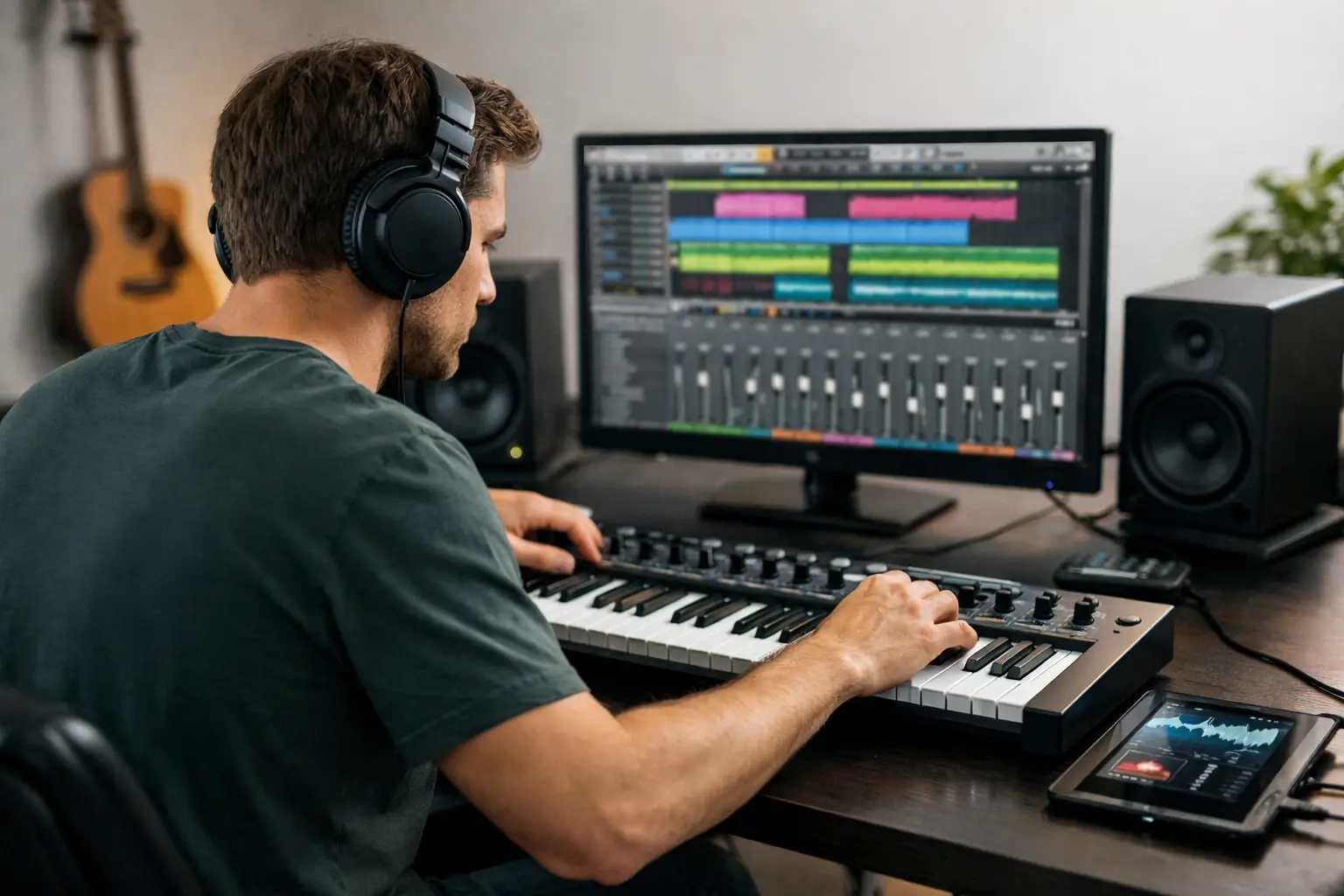
You can watch 200 music production videos and still freeze the moment you open your DAW. That’s the trap. The best way to learn music production is not collecting more content - it’s building skills through guided repetition, small wins, and real project work.
A lot of beginners think they need more inspiration, better plugins, or a giant course library. Usually they need something simpler: a path. If your sessions feel like wandering through a dungeon with no map, the problem probably isn’t your talent. It’s your learning system.
The best way to learn music production is active, not passive
Music production is a performance skill. You do not learn it the same way you learn trivia for a quiz. You learn it by hearing mistakes, making choices, testing ideas, and repeating actions until they stop feeling random.
That’s why passive tutorial watching hits a wall so fast. It can make you feel productive because you’re exposed to new concepts, but exposure is not mastery. Watching someone EQ a vocal is not the same as hearing muddiness in your own track and knowing what to cut. Seeing a producer build a drop is not the same as arranging your own 16 bars without getting lost.
The fastest progress usually comes from a loop that looks like this: learn one concept, apply it immediately, get feedback, then repeat it in a slightly new situation. That’s where skills start to stick.
This is also why random content hopping slows people down. One day it’s compression, the next day it’s mastering, then cinematic scoring, then Serum bass design, then an FL Studio shortcut video. Fun? Sure. Effective? Not really. If every session is a side quest, your main storyline never advances.
Why most people stall out
Most new producers don’t quit because they hate music. They quit because the game feels unwinnable. There are too many buttons, too many opinions, and too many moments where you think, “I have no idea what I’m supposed to work on today.”
Information overload is a real boss battle. So is inconsistency. If you only make music when you feel inspired, your learning speed becomes wildly unreliable. One great Saturday cannot carry three weeks of doing nothing.
There’s also a sneaky problem that doesn’t get talked about enough: low-quality practice. If you spend two hours tweaking presets without understanding why something sounds better or worse, you might be busy without actually leveling up. Time matters, but focused reps matter more.
What the best learning path actually looks like
If you want a better answer to the question “what’s the best way to learn music production,” think less like a content consumer and more like a player moving through skill levels.
Start with your DAW, not the entire universe of production. Pick one DAW and stay loyal to it long enough to build fluency. Ableton, FL Studio, Logic, Cubase, Pro Tools, Studio One - they can all get you to strong results. Switching every month because another workflow looks cooler just resets your muscle memory.
Then focus on the core skill tree. You need a foundation in arrangement, drums, bass, melody, sound selection, EQ, compression, reverb, delay, automation, and basic mixing balance. You do not need expert-level mastering on day one. You do not need advanced modular synthesis before you can finish a clean 2-minute track.
The order matters more than people think. Learning advanced sound design before you can build a solid groove is like farming legendary gear before you know the map. It feels impressive, but it does not solve your biggest problem.
Learn in short missions, not marathon chaos
Long sessions can feel serious, but they’re not always effective. Beginners often make faster progress with shorter, repeatable sessions that have a clear target.
One day, your mission might be programming punchy drums. Another day, it might be balancing levels using only volume and panning. Another might be recreating a synth patch by ear. These focused challenges make improvement measurable. You know what you practiced, and you know whether you got better.
That measurable feeling matters. Music production gets frustrating when progress is invisible. If your only benchmark is “make a masterpiece,” you’ll feel stuck for a long time. If your benchmark is “today I built a cleaner low end than last week,” you can actually track your XP.
This is where structured learning beats randomness every time. A good system breaks the giant skill of music production into smaller battles you can win.
Feedback is the cheat code
You can’t always hear your own weaknesses clearly, especially early on. That’s normal. Your ears are still being trained.
Feedback speeds up everything because it closes the gap between what you meant to do and what actually happened. Maybe your drums feel weak because your transient shaping is off. Maybe your mix sounds muddy because too many instruments are fighting in the same range. Maybe your drop feels disappointing because the tension never built properly in the section before it.
Without feedback, you can repeat the same mistake for months and call it practice. With feedback, you can fix it in a week.
This feedback can come from mentors, peers, guided quizzes, ear training, reference comparisons, or systems that push you to identify what you’re hearing instead of guessing. The exact source matters less than the loop. Make, compare, adjust, repeat.
Finish more tracks, even the bad ones
A lot of producers live in the 8-bar loop dungeon. Everything sounds exciting for 20 minutes, then the project gets abandoned because arrangement suddenly feels impossible.
Finishing tracks is not just about discipline. It teaches a completely different set of skills: transitions, energy management, variation, restraint, and decision-making under pressure. These are production muscles you cannot fully train by endlessly polishing intros.
That does not mean every track needs to be released. Some tracks exist to teach you one lesson. Finish them anyway. A mediocre finished song often teaches more than a brilliant unfinished loop.
There’s a trade-off here. If you finish everything no matter what, you may spend too long forcing dead ideas. If you abandon everything the moment it gets hard, you never develop endurance. The sweet spot is to finish most learning projects while giving yourself permission to move on from the occasional truly broken one.
Ear training matters more than another plugin
A lot of beginners chase gear because gear feels like progress. But better hearing beats better software almost every time.
Ear training helps you recognize compression, frequency buildup, stereo width, distortion, pitch, intervals, and tonal balance. It turns production from guessing into decision-making. Instead of twisting knobs and hoping, you start hearing what the track actually needs.
This is one reason challenge-based learning works so well. When you’re asked to identify a sound, fix a mix issue, or recreate a pattern, you stop being a spectator. Your brain has to engage. That friction is good. That’s where retention happens.
The best way to learn music production for your goals
There isn’t one universal route for everyone. The best way to learn music production depends partly on what you want to make.
If you want to release electronic tracks, you’ll probably spend more time on drum programming, synthesis, automation, and arrangement for drops and builds. If you want to record singer-songwriter material, editing, mic technique, vocal processing, and mix clarity may matter more earlier. If you want to make beats, groove, sample manipulation, and low-end control might become your core grind.
The fundamentals still overlap. But your practice should match your questline.
This is where DAW-specific paths and targeted exercises help a lot. General knowledge is useful, but context makes it stick. Learning sidechain compression inside the kind of track you actually make beats learning it as abstract theory every time.
Motivation is not enough. You need momentum.
Waiting to feel inspired is one of the slowest ways to improve. Momentum beats mood.
The producers who get good are usually not the ones with the most natural talent. They’re the ones who keep showing up, even for 20 focused minutes, because their learning system gives them clear next steps. A daily challenge, a visible streak, a skill path, a quick recap, a boss battle at the end of a module - all of that reduces friction. It keeps you in motion.
That’s why game-like learning works so well for modern producers. It turns vague ambition into concrete progression. Instead of thinking, “I should get better at music,” you think, “Today I’m clearing this rhythm challenge and tomorrow I’m tackling EQ.” SoundSurf leans into that idea because it matches how people actually build skills: through repetition, feedback, and small victories that stack.
If you want real progress, stop trying to consume your way into becoming a producer. Pick a DAW. Follow a structured path. Practice in short missions. Train your ears. Finish more songs. Get feedback. Then do it again tomorrow.
That’s not the flashiest answer. It’s just the one that gets you out of the tutorial graveyard and into real level-ups.