
Sound Design & Synthesis
Music Production Quizzes Online That Help
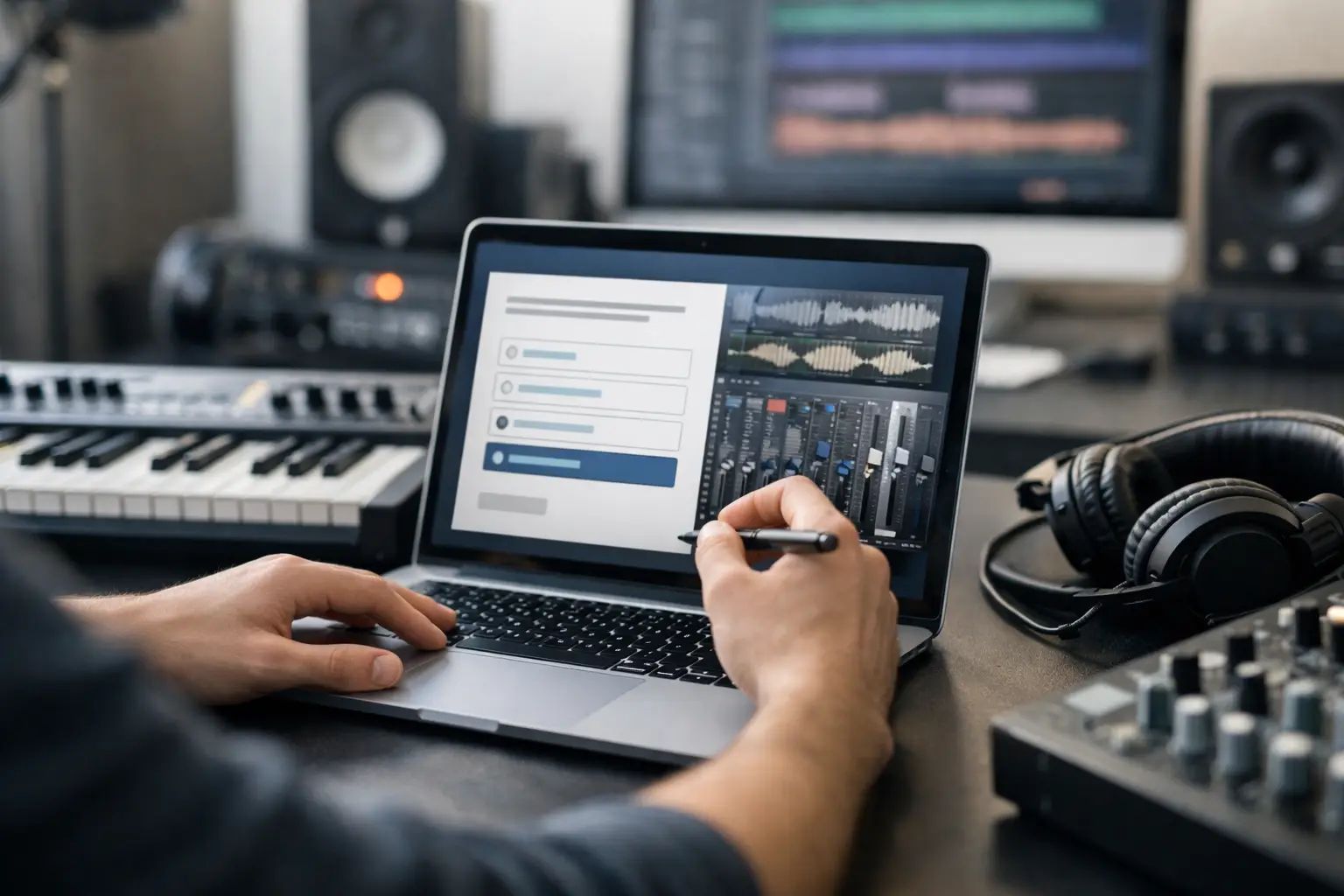
You can watch three hours of beat-making videos, nod along like you get compression, and still freeze the second someone asks what attack and release actually do. That is exactly why music production quizzes online have become so useful for beginner and intermediate producers. A good quiz does not just check whether you remember a term. It reveals whether the concept is actually living in your hands, your ears, and your session choices.
A lot of producers hit the same wall. They consume content constantly, but their skill tree barely moves. They know what a low-pass filter is in theory, yet still carve up a sound the wrong way. They recognize DAW features when they see them, but cannot recall them when they need them. Quizzes, when designed well, break that passive loop. They force recall, expose weak spots, and turn vague confidence into measurable progress.
Why music production quizzes online work better than passive tutorials
The biggest advantage is simple - a quiz makes you do something. Tutorials are easy to mistake for learning because they feel productive. You are watching, listening, even taking notes. But recognition is not the same as recall, and recall is not the same as application.
When you answer a question about EQ ranges, identify a waveform by sight, or choose the right routing option for a send effect, your brain has to retrieve information instead of just noticing it. That retrieval strengthens memory. In music production, that matters because the whole game is fast decisions. You do not want to stop a creative session to relearn gain staging for the fifth time.
There is also a motivation factor. A quiz gives you a checkpoint. You get feedback now, not weeks later when your mix still sounds muddy and you are not sure why. That immediate response can be the difference between staying in the dungeon and quitting the run.
Not all music production quizzes online are worth your time
Here is the trade-off. Some quizzes are basically trivia in studio clothing. They ask you to define MIDI, name famous compressors, or identify random terminology that sounds impressive but does very little for your workflow. Those can be mildly entertaining, but they do not always move your production forward.
The better kind of quiz sits closer to real use. It asks questions that connect to choices you make inside a DAW. For example, what happens when two sounds fight in the same frequency range? Why would you automate reverb on a transition instead of leaving it static? When should you use subtraction in EQ before reaching for saturation? Those questions build production judgment, not just vocabulary.
This is where format matters. Multiple choice can be great for speed and repetition, but it has limits. Ear training quizzes, drag-and-drop routing tasks, waveform matching, and DAW-specific challenge questions usually teach more because they mimic actual decisions. If a quiz cannot bridge the gap between concept and session, it is probably side quest content, not main campaign material.
What a good quiz should actually test
If you are hunting for useful quiz-based learning, look for coverage across the core zones of production. Theory is part of it, but only part. You want quizzes that test timing, arrangement logic, mixing basics, sound design fundamentals, and ear training.
Ear training is a big one because it is where many producers struggle quietly. It is easy to memorize what a harsh upper-mid boost means on paper. It is harder to hear it. Quizzes that train you to identify EQ boosts, compression changes, stereo width, distortion, and reverb types build the kind of instinct that saves mixes.
DAW-specific knowledge matters too, especially for beginners. If you use Ableton, FL Studio, Logic, or another major workstation, your learning sticks faster when questions reflect the actual tools and menus you use every day. General production knowledge is helpful, but practical recall inside your chosen setup is what turns study time into finished tracks.
A strong quiz should also scale. If every question feels too easy, you are farming low-level XP. If every question feels impossible, the game is badly balanced. The sweet spot is challenge with momentum. You should miss enough questions to spot gaps, but not so many that the whole thing feels like punishment.
The real value is habit, not just scores
This is where most people misunderstand quizzes. The score is not the prize. The habit is.
Short, repeatable testing sessions are powerful because they create consistency without demanding a huge block of time. Ten focused minutes of answering production questions, identifying frequencies, or recalling signal flow can do more for long-term progress than one giant cram session on a Sunday. Music skills grow from repeated exposure and repeated action.
That is especially true for producers who get overwhelmed by giant course libraries or endless tutorial playlists. A quiz gives you a small, clear mission. Finish the challenge. See what you missed. Run it back. That feedback loop is clean, and clean loops build momentum.
Gamified systems help here too, as long as they are not just cosmetic. XP, streaks, achievements, daily challenges, and level progression can keep you showing up, but only if the learning underneath is real. A shiny badge for guessing random terms gets old fast. A badge tied to improved recall, stronger ears, or DAW fluency feels earned.
How to use quizzes without stalling your actual music
There is a catch. You can absolutely overdo quiz-based learning and end up becoming amazing at answering questions instead of making songs. That is not the goal.
The best way to use quizzes is as reinforcement between sessions, not a replacement for sessions. If you learn about sidechain compression, quiz it, then use it in a project. If you review arrangement structures, apply that knowledge to a track sketch. If you train your ear on reverb tails, go test that ear in a mix.
Think of quizzes as your training grounds and your DAW as the boss battle. One prepares you. The other proves it.
A useful rhythm for most producers is simple. Learn a concept, test it quickly, then build something with it. That cycle keeps knowledge from floating around as trivia. It anchors the lesson in real creative work.
Who benefits most from music production quizzes online
Beginners usually get the biggest boost because they are still building their map of the territory. They need structure, repetition, and proof that things are sticking. Quizzes help them sort out what they know, what they kind of know, and what they only recognize when someone else explains it.
Intermediate producers can benefit too, but in a different way. For them, quizzes are often less about first exposure and more about sharpening weak zones. Maybe their drums slap but their harmonic knowledge is shaky. Maybe they can write but not mix. Maybe they understand synth basics but cannot identify modulation choices by ear. A targeted quiz system can expose those blind spots faster than guesswork.
The format is also great for producers with inconsistent schedules. If your week is packed with school, work, or life chaos, a quick interactive session still keeps the skill chain alive. That matters more than people think. Consistency beats intensity most of the time.
What to look for before you commit
If you are comparing platforms or tools, look beyond the promise of fun. Ask whether the quizzes are part of a real learning path or just scattered mini-games. Ask whether they connect to lessons, recap what you missed, and adapt as you improve. Ask whether they test ears and decision-making, not just definitions.
You should also pay attention to feedback quality. Telling you that an answer is wrong is the bare minimum. Telling you why it is wrong, and what concept to review, is where actual progress starts.
If the platform includes challenge-based progression, daily practice loops, and software-specific paths, that usually signals stronger design. SoundSurf leans into that style because producers do better when learning feels like an active quest instead of a giant pile of content.
Music production is already hard enough without trying to level up through random clips and half-remembered notes. The right quiz system turns learning into a series of wins you can feel, track, and build on. And when your next session opens up, you are not just hoping you learned something. You are carrying better instincts into the room.